| by Justin Thomas |
The theory is known: George Lucas and Steven Spielberg did nothing more than make exceptional B Movies early in their careers. That would be the worst type of Wikipedia entry because I can’t attribute it to anyone, but if someone wanted to theorize as to what Lucas and Spielberg did, makers of exceptional B Movies would be a good theory.
Right.
B Movies weren’t very good. Matinee and the Mant! movie-within-the-movie show how bad B Movies were and why they worked. The brilliance of Lucas and Spielberg isn’t that they made B Movies as they were but B Movies as they remembered them because if they’d made B Movies as they were, we wouldn’t know their names. It’s the fundamental flaw of Shyamalan’s The Happening because he made a movie based on the quality of the B Movies and not how they were viewed by audiences at the time. Mant! enjoys of having the luxury of making a B Movie of B Movie quality because it’s necessary to tell the story of Matinee so Mant! can have the ridiculous exposition, the terrible acting and the ludicrous idea and have it work. There’s simply no way Mant! could be a standalone “real” movie today, which is one reason why The Happening failed.
What Matinee wants to do is show a part of the movies that no longer exists where showmanship played a key role. John Goodman’s Lawrence Woolsey not only wants to be Alfred Hitchcock, straight down to the silhouette and introduction of his movies to their audiences, but he also gets Hitchcock because he thinks about the audience. A lot. To the point of putting buzzers beneath their seats. This existed but it does so no longer, and if you wonder if it might still be around, ask yourself when you last saw a trailer where the director introduces his movie.
The Cuban Missile Crisis serves a backdrop to Woolsey bringing Mant! and his version of 3D to Key West and he uses the heightened state of tension to his advantage. Should he be concerned about showing an atomic bomb blast complete with manufactured heat and smoke to an audience viewing it 90 miles from Cuba in October 1962? Nope. It’ll help sell the experience, which is what he needs because he has the next big idea in movie showmanship. It’s not a lack of concern for his fellow man but a prioritization of his needs slightly above concern for his fellow man, which Woolsey shows he can reprioritize when necessary when he gives up the gate money to save his girl from a knife-wielding, ant-costume-wearing JD.
Goodman is good as Woolsey but it’s not much more than John Goodman as a character named Lawrence Woolsey. It doesn’t seem as though there’s much acting going on, but Goodman is so likeable he doesn’t need to really act. Goodman as Woolsey works just fine. He has the ability to act, which he’s shown on occasion, but Goodman on screen just being John Goodman is sometimes worth the price of admission. Walter Sobchak is just John Goodman written with a lot of caffeine in his system and weird personal experience stories in his background. The point: he might not be of the order of Daniel Day Lewis but John Goodman has a place in the movies and one need only see Matinee once to know why.
Does Matinee work as a movie? Yes, in the same way A Christmas Story works but without the backbreaking laughs. Matinee is also 10% better than it would have otherwise been because it includes John Sayles in the cast. I first saw it in 1994 and remember loving it to the point of always mentioning it and my affinity for it during conversations about movies. Then I watched the movie again but didn’t love it as much. It didn’t work as well, or I’d changed, or something happened and it wasn’t as good as it was in my memory, which is interesting given Matinee is about B Movies. There’s a joke in there somewhere.
Friday, August 13, 2010

Thursday, August 12, 2010
Are You There, God? It’s Me, Boston: Game 6
| by Justin Thomas |
I don’t believe in God. I believe in Thomas Jefferson.
Michael Hoffman's Game 6 needs the viewer to either believe in God or at least know about the concept for the pivotal scene to work. Wrapping baseball into the mix, particularly that Game 6, helps bring the notion of God, or a god, into a place where God, or a god, seems to function well. Baseball, baseball players and baseball fans are weird people and the game is so wrapped into the psyche of those involved at any level it’s difficult to allow it in and not believe in something more powerful controlling things.
Nicky sits in a New York bar on the night in 1986 when the Mets came from behind to defeat the Red Sox and force a Game 7. Prior to 2004, that night is the night Red Sox fans can point to when needing to explain the cross they carried, and Nicky explains at length over the course of the film why that’s the case. He doesn’t mention curses or baseball gods working against Red Sox Nation, but the idea of the higher power enters into the conversation as the innings wane and the Red Sox near what Nicky knows will be the collapse. In a stunning piece of authenticity, not a hindsight wink at a fanbase, Nicky knew they’d blow it. It was just a matter of how and how excruciating it would be when it happened.
But then Toyota, his cabbie and his guest for the drama of Game 6, asks Nicky to start believing in something. Hesitantly he does so. Maybe this isn’t the one that’ll crush him. Maybe this is the one that will work. She tells him to start believing in his team. He starts believing in his team. Mookie Wilson hits the dribbler down the first base line. Bill Buckner moves over, grabs the ball and Nicky sees him tag the base, ending the threat. The game continues and Nicky is unaware of what’s happened, what’s really happened, until later when two Mets fans help explain things to him in a way only Mets fans can do.
What did the kind and merciful God do for Nicky that night? The Red Sox didn’t win; the outcome remained the same. The kind and merciful deity, whomever that might be, spared him the moment of watching Buckner botch the play, yet another moment in Red Sox history in a long, long line of moments in Red Sox history that weighs down a fan. He won’t be able to discuss with other Red Sox fans what his heart did at that moment, when he watched Ray Knight cross the plate to force Game 7, and it will be his one missing piece to the puzzle of being a Red Sox fan.
I don’t know how to discuss an independent film, one that strays not from the formula of a movie but from the form of a movie. Nicky bothered me because every line of dialogue was so writer-y which fits because he’s a writer but it gets old. Michael Keaton shows, as he frequently shows, he’s capable of more than Multiplicity (as is Harold Ramis but that’s a rant better saved for another time). I know there are themes to be found, things to be discussed and ideas to be pondered, but I got hung up on that one moment and how it affects Nicky’s showdown with the Phantom of Broadway. See, Red Sox Nation didn’t hold a monopoly on baseball frustration before 2004 and it certainly doesn’t now.
Why should someone see Game 6? Red Sox fans don’t need to because what happened and that mindset is no longer applicable; enjoy the two titles, forgive Buckner and head to Fenway if for no other reason than the greater glory of the Fenway Frank. Baseball fans on the North Side don’t need to see it because being a baseball fan on the North Side means beer and broads, not baseball. Maybe I’m recommending it to Michael Keaton fans. You know you’re really talking to a Liam Neeson fan if that person has seen Seraphim Falls, or a Tony Curtis fan if they’ve seen Sweet Smell of Success. Keaton is a fine performer and this is one of those hidden nuggets of gold in his filmography. So get thee to a video store quickly, you Michael Keaton Nation, and see this for what he does with Nicky.
And for anyone who gets angry at losing a Game 6 and allowing that to dominate how one remembers a series? Losing Game 6 always, always, always means Game 7 can still be won. Boston had a 3-0 lead in Game 7 until the bottom of the sixth inning.
Buckner wasn’t the only one at fault.
I don’t believe in God. I believe in Thomas Jefferson.
Michael Hoffman's Game 6 needs the viewer to either believe in God or at least know about the concept for the pivotal scene to work. Wrapping baseball into the mix, particularly that Game 6, helps bring the notion of God, or a god, into a place where God, or a god, seems to function well. Baseball, baseball players and baseball fans are weird people and the game is so wrapped into the psyche of those involved at any level it’s difficult to allow it in and not believe in something more powerful controlling things.
Nicky sits in a New York bar on the night in 1986 when the Mets came from behind to defeat the Red Sox and force a Game 7. Prior to 2004, that night is the night Red Sox fans can point to when needing to explain the cross they carried, and Nicky explains at length over the course of the film why that’s the case. He doesn’t mention curses or baseball gods working against Red Sox Nation, but the idea of the higher power enters into the conversation as the innings wane and the Red Sox near what Nicky knows will be the collapse. In a stunning piece of authenticity, not a hindsight wink at a fanbase, Nicky knew they’d blow it. It was just a matter of how and how excruciating it would be when it happened.
But then Toyota, his cabbie and his guest for the drama of Game 6, asks Nicky to start believing in something. Hesitantly he does so. Maybe this isn’t the one that’ll crush him. Maybe this is the one that will work. She tells him to start believing in his team. He starts believing in his team. Mookie Wilson hits the dribbler down the first base line. Bill Buckner moves over, grabs the ball and Nicky sees him tag the base, ending the threat. The game continues and Nicky is unaware of what’s happened, what’s really happened, until later when two Mets fans help explain things to him in a way only Mets fans can do.
What did the kind and merciful God do for Nicky that night? The Red Sox didn’t win; the outcome remained the same. The kind and merciful deity, whomever that might be, spared him the moment of watching Buckner botch the play, yet another moment in Red Sox history in a long, long line of moments in Red Sox history that weighs down a fan. He won’t be able to discuss with other Red Sox fans what his heart did at that moment, when he watched Ray Knight cross the plate to force Game 7, and it will be his one missing piece to the puzzle of being a Red Sox fan.
I don’t know how to discuss an independent film, one that strays not from the formula of a movie but from the form of a movie. Nicky bothered me because every line of dialogue was so writer-y which fits because he’s a writer but it gets old. Michael Keaton shows, as he frequently shows, he’s capable of more than Multiplicity (as is Harold Ramis but that’s a rant better saved for another time). I know there are themes to be found, things to be discussed and ideas to be pondered, but I got hung up on that one moment and how it affects Nicky’s showdown with the Phantom of Broadway. See, Red Sox Nation didn’t hold a monopoly on baseball frustration before 2004 and it certainly doesn’t now.
Why should someone see Game 6? Red Sox fans don’t need to because what happened and that mindset is no longer applicable; enjoy the two titles, forgive Buckner and head to Fenway if for no other reason than the greater glory of the Fenway Frank. Baseball fans on the North Side don’t need to see it because being a baseball fan on the North Side means beer and broads, not baseball. Maybe I’m recommending it to Michael Keaton fans. You know you’re really talking to a Liam Neeson fan if that person has seen Seraphim Falls, or a Tony Curtis fan if they’ve seen Sweet Smell of Success. Keaton is a fine performer and this is one of those hidden nuggets of gold in his filmography. So get thee to a video store quickly, you Michael Keaton Nation, and see this for what he does with Nicky.
And for anyone who gets angry at losing a Game 6 and allowing that to dominate how one remembers a series? Losing Game 6 always, always, always means Game 7 can still be won. Boston had a 3-0 lead in Game 7 until the bottom of the sixth inning.
Buckner wasn’t the only one at fault.
Tuesday, August 10, 2010
You’re No Daisy: Tombstone
| by Justin Thomas |
Lora Kennedy either had a tremendous grudge against the Tombstone production or was told to go cast as many bad actors as humanly possible. If the direction were the latter, then she pulled a Hank Aaron and knocked the ball clean out of Milwaukee County Stadium because it’s a veritable Who’s Who of absolutely crap actors.
Here’s the list of garbage: Bill Paxton, Powers Boothe, Michael Biehn, Stephen Lang and Thomas Haden Church. I didn’t include Sam Elliott and Charlton Heston in the list of trash only to keep from getting torched but let me tell you, they nearly made it.
Tombstone desperately wants to be a good, old timey Western, and it succeeds. After the opening narration by the Bad Ass To End All Bad Asses Robert Mitchum (look it up, that’s his official title), it goes right into the Cowboys laying waste to a wedding in which Johnny Ringo takes aim and helps a priest pass along to eternal bliss. There is no gray in Tombstone: you’re either good or you’re bad and the end of your story will be written accordingly. Doc isn’t gray although the movie might want you to think he is; he’s there for Wyatt far too often to truly believe in his hypocrisy. The good guys are good, the bad guys are bad, and anyone wearing a red sash is going to die.
Where Tombstone runs off the tracks is in the performances from the aforementioned Big Five of Shite: Paxton, Boothe, Biehn, Lang and Church. They’re given lines such as “I want your blood, and I want your souls, and I want them both right now,” and “Listen, Mr. Kansas Law Dog, law don’t go around here, savvy?” Those hyper-macho lines, which have a place in a Western actually attempting to be a Western, are dangerous lines when put in the hands of people who can’t handle them because they think they’re a joke. There’s something behind the eyes, and in the smirk, that says Biehn and Lang both understand just how ridiculous they sound, and rather than do anything to try to sell them, they wink at the camera through the entire movie.
So then enters two honest-to-goodness Movie Stars. Capital letters. Guys who would have done just fine in the 1940s or 1950s heading up studio picture after studio picture. Kurt Russell and Val Kilmer also know they’re in a movie where the testosterone needs to be visible and they’re both given equally if not more ridiculous lines to say, but what separates them from the rest of the production is they know how to do it. They don’t wink at the camera. They don’t acknowledge through a smirk how they aren’t necessarily being asked to play Hamlet.
In Russell’s key scene, Earp sees his family off at the train station. He knows the Cowboys will be there to end the conflict. He intends to send a message. He’s given lines where he has to put the fear of God into Ike which crescendos from “So run, you cur, run, tell all the other curs the law’s comin’,” to “And Hell’s comin’ with me, you hear, Hell’s comin’ with me!” Under no circumstances would that win an Academy Award for Best Writing, but Russell pulls it off. There’s no rolling of the eyes or “Gimme a break” from it. Nope. It’s just Kurt Russell as Wyatt Earp preparing to bring a reckoning to those who wronged him, and he gives the line in such a way there is little doubt he means to accomplish it. A nuanced performance it is not. It’s simply what a Movie Star does when he’s given a part he wants to sink his teeth into.
As for Kilmer? He disappears into Doc. He’s easy going, intelligent, devil-may-care unless it’s time to throw down then there’s little hope for the guy on the other side, and he’ll oblige you with a learned quote as you pass along to the other side. His lines aren’t as questionable as “You skin that smoke wagon and we’ll see what happens,” but they also aren’t in the realm of authentic to anything Kilmer could possibly know.
Tombstone isn’t a particularly good movie as measured by being anything other than being a two-hour amusement park ride. It’s probably best viewed in the television room of a frat house with rules established as to when one takes a drink or when someone needs a Dana Delany fix and is upset Netflix doesn’t have China Beach or Exit to Eden on instant download. It’s best suited to illustrate the difference between Movie Stars and guys who stand in front of a camera. How I hate, hate, hate Bill Paxton.
Lora Kennedy either had a tremendous grudge against the Tombstone production or was told to go cast as many bad actors as humanly possible. If the direction were the latter, then she pulled a Hank Aaron and knocked the ball clean out of Milwaukee County Stadium because it’s a veritable Who’s Who of absolutely crap actors.
Here’s the list of garbage: Bill Paxton, Powers Boothe, Michael Biehn, Stephen Lang and Thomas Haden Church. I didn’t include Sam Elliott and Charlton Heston in the list of trash only to keep from getting torched but let me tell you, they nearly made it.
Tombstone desperately wants to be a good, old timey Western, and it succeeds. After the opening narration by the Bad Ass To End All Bad Asses Robert Mitchum (look it up, that’s his official title), it goes right into the Cowboys laying waste to a wedding in which Johnny Ringo takes aim and helps a priest pass along to eternal bliss. There is no gray in Tombstone: you’re either good or you’re bad and the end of your story will be written accordingly. Doc isn’t gray although the movie might want you to think he is; he’s there for Wyatt far too often to truly believe in his hypocrisy. The good guys are good, the bad guys are bad, and anyone wearing a red sash is going to die.
Where Tombstone runs off the tracks is in the performances from the aforementioned Big Five of Shite: Paxton, Boothe, Biehn, Lang and Church. They’re given lines such as “I want your blood, and I want your souls, and I want them both right now,” and “Listen, Mr. Kansas Law Dog, law don’t go around here, savvy?” Those hyper-macho lines, which have a place in a Western actually attempting to be a Western, are dangerous lines when put in the hands of people who can’t handle them because they think they’re a joke. There’s something behind the eyes, and in the smirk, that says Biehn and Lang both understand just how ridiculous they sound, and rather than do anything to try to sell them, they wink at the camera through the entire movie.
So then enters two honest-to-goodness Movie Stars. Capital letters. Guys who would have done just fine in the 1940s or 1950s heading up studio picture after studio picture. Kurt Russell and Val Kilmer also know they’re in a movie where the testosterone needs to be visible and they’re both given equally if not more ridiculous lines to say, but what separates them from the rest of the production is they know how to do it. They don’t wink at the camera. They don’t acknowledge through a smirk how they aren’t necessarily being asked to play Hamlet.
In Russell’s key scene, Earp sees his family off at the train station. He knows the Cowboys will be there to end the conflict. He intends to send a message. He’s given lines where he has to put the fear of God into Ike which crescendos from “So run, you cur, run, tell all the other curs the law’s comin’,” to “And Hell’s comin’ with me, you hear, Hell’s comin’ with me!” Under no circumstances would that win an Academy Award for Best Writing, but Russell pulls it off. There’s no rolling of the eyes or “Gimme a break” from it. Nope. It’s just Kurt Russell as Wyatt Earp preparing to bring a reckoning to those who wronged him, and he gives the line in such a way there is little doubt he means to accomplish it. A nuanced performance it is not. It’s simply what a Movie Star does when he’s given a part he wants to sink his teeth into.
As for Kilmer? He disappears into Doc. He’s easy going, intelligent, devil-may-care unless it’s time to throw down then there’s little hope for the guy on the other side, and he’ll oblige you with a learned quote as you pass along to the other side. His lines aren’t as questionable as “You skin that smoke wagon and we’ll see what happens,” but they also aren’t in the realm of authentic to anything Kilmer could possibly know.
Tombstone isn’t a particularly good movie as measured by being anything other than being a two-hour amusement park ride. It’s probably best viewed in the television room of a frat house with rules established as to when one takes a drink or when someone needs a Dana Delany fix and is upset Netflix doesn’t have China Beach or Exit to Eden on instant download. It’s best suited to illustrate the difference between Movie Stars and guys who stand in front of a camera. How I hate, hate, hate Bill Paxton.
Monday, August 9, 2010
Remake v. Remade: Dawn of the Dead
| by Justin Thomas |
MTV did more than kill the radio star when it debuted in 1981. MTV also started editing on its path to the seizure-inducing 0.05-second cuts currently masquerading as style. Gregg Toland had style. People wishing to make long-form cinematic works would have been better served watching TCM than MTV.
The two Dawn of the Dead films, the original by George A. Romero and the remake by Zack Snyder, show the dramatic difference between filmmaking in 1978 and filmmaking in 2004. Romero lets his cuts and sequences run long, which wouldn’t have felt out of place upon release but seems slow today. Snyder has a bit of Bay in him and he also goes the handheld route during intense action sequences that, even only six years post-Saving Private Ryan, was overused.
Both films have essentially the same stories: survivors of the zombie apocalypse seek shelter in a mall. They feature characters of the respective eras. In the original, Francine sits in a room separated from the men while they discuss her pregnancy and what to do before she later tells the father she wants to have a say in it. The remake has Ana as a tough-as-nails nurse who screams at CJ, “Get that fucking gun out of my face.” They both have A-Team sequences where they must build things to stop the zombie attacks be it a false wall to keep secret their hideout in the original or A-Team vans designed to get the survivors from the mall to the marina. There’s enough in Snyder’s film to look at it as taking the original and making it applicable to the era in which it was made while leaving just enough to see they both sprang from the same source.
Romero’s film is slow. Once the survivors lockdown the mall and even go so far as to put the corpses in a freezer, the film moves into character development mode. For what seems like an hour, they build a nice little apartment in their hideout, ice skate, have a date or two and Francine even learns how to fly a helicopter, but with the zombies outside all but neutralized, it fizzles. There’s no urgency driving the movie forward until the biker gang finds the mall. From the end of securing the mall until the bikers show up, the film is in “let’s play house” mode and it’s long, long, long.
Snyder’s film sacrifices time to round out the characters to keep things moving. They lock down the mall and then have the obligatory shopping scenes, but there are other things to do. A second group of survivors forces them to understand how the bite works and how even a dad needs to be put down if he’s been bitten. There’s not just a pregnancy but a birth. There’s a friend across the parking lot stranded alone in a building who needs help. There are things to do and Snyder’s film can’t be asked to wait around.
They’re products of their times, but if an entire world populating having turned into the living dead is what they share then Snyder’s film makes better use of the situation by not allowing for much time to breathe. The situation that drives the breach in the mall that forces the survivors out is less contrived in Snyder’s film. Romero has the satire down pat, which is completely abandoned by Snyder, but if constructing a plot in such a way to keep the audience’s interest is the measuring stick, then Snyder has a leg up on the original. It’s not blasphemous to suggest Snyder did something better in the remake of an all-time classic because the original has issues. The remake also has issues but improvements in certain aspects were made.
Every single aspect of Romero’s film is dated. There isn’t a single thing, straight down to the Penney’s logo, cripes, even it being called Penney’s and not JCPenney, that isn’t locked down in the late 1970s. Snyder’s film will one day be just as dated based on how he uses the camera and maybe it will be just as unsettling and foreign thirty years from now as Romero’s film is to watch now.
So there you have it: you can tell MTV launched and completely destroyed Western Civilization between Romero’s Dawn of the Dead and Snyder’s remake.
MTV did more than kill the radio star when it debuted in 1981. MTV also started editing on its path to the seizure-inducing 0.05-second cuts currently masquerading as style. Gregg Toland had style. People wishing to make long-form cinematic works would have been better served watching TCM than MTV.
The two Dawn of the Dead films, the original by George A. Romero and the remake by Zack Snyder, show the dramatic difference between filmmaking in 1978 and filmmaking in 2004. Romero lets his cuts and sequences run long, which wouldn’t have felt out of place upon release but seems slow today. Snyder has a bit of Bay in him and he also goes the handheld route during intense action sequences that, even only six years post-Saving Private Ryan, was overused.
Both films have essentially the same stories: survivors of the zombie apocalypse seek shelter in a mall. They feature characters of the respective eras. In the original, Francine sits in a room separated from the men while they discuss her pregnancy and what to do before she later tells the father she wants to have a say in it. The remake has Ana as a tough-as-nails nurse who screams at CJ, “Get that fucking gun out of my face.” They both have A-Team sequences where they must build things to stop the zombie attacks be it a false wall to keep secret their hideout in the original or A-Team vans designed to get the survivors from the mall to the marina. There’s enough in Snyder’s film to look at it as taking the original and making it applicable to the era in which it was made while leaving just enough to see they both sprang from the same source.
Romero’s film is slow. Once the survivors lockdown the mall and even go so far as to put the corpses in a freezer, the film moves into character development mode. For what seems like an hour, they build a nice little apartment in their hideout, ice skate, have a date or two and Francine even learns how to fly a helicopter, but with the zombies outside all but neutralized, it fizzles. There’s no urgency driving the movie forward until the biker gang finds the mall. From the end of securing the mall until the bikers show up, the film is in “let’s play house” mode and it’s long, long, long.
Snyder’s film sacrifices time to round out the characters to keep things moving. They lock down the mall and then have the obligatory shopping scenes, but there are other things to do. A second group of survivors forces them to understand how the bite works and how even a dad needs to be put down if he’s been bitten. There’s not just a pregnancy but a birth. There’s a friend across the parking lot stranded alone in a building who needs help. There are things to do and Snyder’s film can’t be asked to wait around.
They’re products of their times, but if an entire world populating having turned into the living dead is what they share then Snyder’s film makes better use of the situation by not allowing for much time to breathe. The situation that drives the breach in the mall that forces the survivors out is less contrived in Snyder’s film. Romero has the satire down pat, which is completely abandoned by Snyder, but if constructing a plot in such a way to keep the audience’s interest is the measuring stick, then Snyder has a leg up on the original. It’s not blasphemous to suggest Snyder did something better in the remake of an all-time classic because the original has issues. The remake also has issues but improvements in certain aspects were made.
Every single aspect of Romero’s film is dated. There isn’t a single thing, straight down to the Penney’s logo, cripes, even it being called Penney’s and not JCPenney, that isn’t locked down in the late 1970s. Snyder’s film will one day be just as dated based on how he uses the camera and maybe it will be just as unsettling and foreign thirty years from now as Romero’s film is to watch now.
So there you have it: you can tell MTV launched and completely destroyed Western Civilization between Romero’s Dawn of the Dead and Snyder’s remake.
Thursday, August 5, 2010
Don't Bother: The Wolfman
| by Allan Stackhouse |
Before you read this, please note that I watched the Unrated Version of the film as opposed to the Theater Version. What can I say, more blood and more guts is a selling point for me.
Upon seeing the trailer on TV, I remember being awestruck by the cast of Joe Johnston: Sir Anthony Hopkins, the Canadian marvel Christopher Plummer, and the versatile Benicio del Toro. Unfortunately, I was almost immediately let down by the film. Christopher Plummer appears in one scene (for which he is apparently not credited). Despite the name draw, none of the actors' performances provide enough to compensate for such a blatant lack of story.
Benicio plays Lawrence Talbot, a successful theater actor, who returns to his father's house upon the death of his brother. He is traumatized from his mother's suicide. At the start of the film, we can tell that something is amiss with his father, John Talbot. There are some nice bits of visual storytelling that reveal his character: his eyes staying bright while retreating into darkness. In the ambush scene in the first act, people are being decapitated left and right with no sight or sound of their attacker. Lawrence is attacked, bit by the werewolf and making him a werewolf.
I am utterly disappointed by the washed out pallet. Why are the default choices to make something old washing it out? After Effects. I have been to a handful of foreign countries and I'm . Washed out pallets do not work for these supernatural films. They don't work for films as fluffy as Eclipse and they don't work in what was supposed to have been a horror epic.
Hugo Weaving's initial appearance is commanding. I thought the movie was setting up Inspector Abberline as another protagonist, which would have proved an interesting narrative tool. He, himself, is displayed as flawed, not totally welcome by the townspeople for his by-the-book pursuit of the wolf. Yet again, his presence is wasted on a character whom I could care less about. It's quite unfortunate that these wasted characters become a recurring theme for the film: fantastic actor but very little character to act out. The only mildly impressive performance is Sir Anthony Hopkins as John Talbot. In the cell that holds Lawrence, he reveals that he killed Lawrence's mother. Unfortunately, this impressive bit of memorization is the epitome of exposition in the film. This movie simply tells us how to feel at every opportunity it gets.
I had absolutely no emotional attachment to any of these characters. I didn't care about anyone's survival. Not even the damsel in distress, Gwen Confliffe, played by Emily Blunt, another actress for whom I couldn't care less. Granted, she, like the other characters, had very little character to work with but she brings nothing to the table other than her face.
The movie, set in old England, was full of pompous old men. There's something so hilarious about watching pompous old men getting slaughtered that entirely works for this film. Lawrence, upon his first transformation, falls into the trap set by the townspeople but lays waste to their naievite. Twice in the film, they ended up killing another man. This didn't get to the point where it was hokey but it certainly made me chuckle a bit.
The double scare. If you're going to use them, use them sparingly. At first, I found the double scares to be a little lackluster but I found them funny after the second one. They only appeared at the dreams within dreams sequence and it would have been nice for the director to include these in the natural scape of the film but the fact that they put a smile on my face is a major plus.
I did not find the transformation scenes particularly good. The transformations relied entirely on CGI and it wasn't impressive in the least. If you're going to start out with great transformation scenes in 1981's An American Werewolf in London and a near-seamless blend of skin bursting special effects and body crunching visual effects in the Underworld series, you should be able to take it to next level. Especially after the bar was set almost twenty years ago. In Lawrence's first transformation, he writhes off screen and we can barely tell what is going on. The whole fear of the unknown thing does not work here because it's never presented as such. You cannot rely on a tool if you don't know how to use it.
Exposition, exposition, exposition. It's incomprehensible to me that a subject as interesting and scary as lycanthropy is shaved down to irritating dialogue about it. I don't mean to so harshly destroy Joe Johnston but this is the guy that Hollywood goes to when they can't get Spielberg. Spielberg directed both Jurassic Park and the Lost World but passed on Jurassic Park III. Who gets it? Joe Johnston of course. He's also done The Pagemaster and Hidalgo. He did direct October Sky, which I haven't seen, so maybe that's a good sign. His style reaks of the smell of someone filling in for someone else and the unfortunate thing is that it shows. Joe has done wonderful things in the world of art direction - The Empire Strikes Back, Raiders of the Lost Ark, Return of the Jedi - but how he ever landed Captain America, I probably don't even want to know. I don't think he's fit to direct action especially after watching The Wolfman.
Before you read this, please note that I watched the Unrated Version of the film as opposed to the Theater Version. What can I say, more blood and more guts is a selling point for me.
Upon seeing the trailer on TV, I remember being awestruck by the cast of Joe Johnston: Sir Anthony Hopkins, the Canadian marvel Christopher Plummer, and the versatile Benicio del Toro. Unfortunately, I was almost immediately let down by the film. Christopher Plummer appears in one scene (for which he is apparently not credited). Despite the name draw, none of the actors' performances provide enough to compensate for such a blatant lack of story.
Benicio plays Lawrence Talbot, a successful theater actor, who returns to his father's house upon the death of his brother. He is traumatized from his mother's suicide. At the start of the film, we can tell that something is amiss with his father, John Talbot. There are some nice bits of visual storytelling that reveal his character: his eyes staying bright while retreating into darkness. In the ambush scene in the first act, people are being decapitated left and right with no sight or sound of their attacker. Lawrence is attacked, bit by the werewolf and making him a werewolf.
I am utterly disappointed by the washed out pallet. Why are the default choices to make something old washing it out? After Effects. I have been to a handful of foreign countries and I'm . Washed out pallets do not work for these supernatural films. They don't work for films as fluffy as Eclipse and they don't work in what was supposed to have been a horror epic.
Hugo Weaving's initial appearance is commanding. I thought the movie was setting up Inspector Abberline as another protagonist, which would have proved an interesting narrative tool. He, himself, is displayed as flawed, not totally welcome by the townspeople for his by-the-book pursuit of the wolf. Yet again, his presence is wasted on a character whom I could care less about. It's quite unfortunate that these wasted characters become a recurring theme for the film: fantastic actor but very little character to act out. The only mildly impressive performance is Sir Anthony Hopkins as John Talbot. In the cell that holds Lawrence, he reveals that he killed Lawrence's mother. Unfortunately, this impressive bit of memorization is the epitome of exposition in the film. This movie simply tells us how to feel at every opportunity it gets.
I had absolutely no emotional attachment to any of these characters. I didn't care about anyone's survival. Not even the damsel in distress, Gwen Confliffe, played by Emily Blunt, another actress for whom I couldn't care less. Granted, she, like the other characters, had very little character to work with but she brings nothing to the table other than her face.
The movie, set in old England, was full of pompous old men. There's something so hilarious about watching pompous old men getting slaughtered that entirely works for this film. Lawrence, upon his first transformation, falls into the trap set by the townspeople but lays waste to their naievite. Twice in the film, they ended up killing another man. This didn't get to the point where it was hokey but it certainly made me chuckle a bit.
The double scare. If you're going to use them, use them sparingly. At first, I found the double scares to be a little lackluster but I found them funny after the second one. They only appeared at the dreams within dreams sequence and it would have been nice for the director to include these in the natural scape of the film but the fact that they put a smile on my face is a major plus.
I did not find the transformation scenes particularly good. The transformations relied entirely on CGI and it wasn't impressive in the least. If you're going to start out with great transformation scenes in 1981's An American Werewolf in London and a near-seamless blend of skin bursting special effects and body crunching visual effects in the Underworld series, you should be able to take it to next level. Especially after the bar was set almost twenty years ago. In Lawrence's first transformation, he writhes off screen and we can barely tell what is going on. The whole fear of the unknown thing does not work here because it's never presented as such. You cannot rely on a tool if you don't know how to use it.
Exposition, exposition, exposition. It's incomprehensible to me that a subject as interesting and scary as lycanthropy is shaved down to irritating dialogue about it. I don't mean to so harshly destroy Joe Johnston but this is the guy that Hollywood goes to when they can't get Spielberg. Spielberg directed both Jurassic Park and the Lost World but passed on Jurassic Park III. Who gets it? Joe Johnston of course. He's also done The Pagemaster and Hidalgo. He did direct October Sky, which I haven't seen, so maybe that's a good sign. His style reaks of the smell of someone filling in for someone else and the unfortunate thing is that it shows. Joe has done wonderful things in the world of art direction - The Empire Strikes Back, Raiders of the Lost Ark, Return of the Jedi - but how he ever landed Captain America, I probably don't even want to know. I don't think he's fit to direct action especially after watching The Wolfman.
All Things Must Pass: Spencer’s Theater
| by Justin Thomas |
In 1996 I traveled from the little cow town in Missouri in which I found myself to the Big City of Kansas City? Ever been to KC? It isn’t really a Big City like New York is a Big City, but when twenty years of life had been lived in towns with populations ranging from twelve to seventeen thousand, even something as “big” as Kansas City is a Big City.
I digress.
In 1996 I traveled to KC and did the entire KC thing. The Plaza? Cool. Did you know KC has incredible BBQ? I wouldn’t because the guy with whom I was staying insisted on giving me my first taste of Chinese food. Arrowhead Stadium? It’s about as good a place to see a game as there is. But that wasn’t what got me uber jazzed for the trip. I was going to get to go to the AMC 20 in Independence, Missouri and I’d never seen a place with twenty screens! I’d never seen a town with twenty houses so you can imagine how my mind had difficulty comprehending the bigness of that Big City with its twenty screens. In my little hometown we had a little theater with three screens. Three! Add seventeen to that and asking me to comprehend it would be akin to asking me to explain quantum mechanics.
(Want to hear the best part of the trip to the AMC 20? I got carded for The Frighteners, didn’t have my ID and was turned away. At the time I was twenty but couldn’t convince the pimply face behind the counter I could handle the show.)
So we had a little theater with three screens, but it’s past tense, “had” now. The theater, which was the first thing rebuilt after a massive fire destroyed the town in 1931, closed its doors on Sunday night and is no more. The marquee now reads, “Thank you for the memories” and for the next week or so people will reminisce. They’ll drive past and shake their heads lamenting its passing. Maybe one or two will say, “It’s a damn shame,” but it’ll be forgotten by the time Hawkeye football rolls around.
It is indeed a damn shame.
There’s no way I’d be able to calculate how much time I spent in that theater. In 1978 or 1979 my mom took me there to see Superman: The Movie and I can even now see the destruction of Krypton and remember wondering why the people in white weren’t Storm Troopers. I can remember the lobby, which at that point was then newly remodeled. I can remember going to the bathroom, which looked the same then as it did when the theater closed. Maybe I’m forcing different memories into that first one but, as far back as I can remember, Spencer’s theater is there and part of my life.
My best friend and I would see E.T. each summer when the cheap matinee was shown during the town’s Crazy Days. I frequently went there to see a movie to escape from the Midwestern heat to the comfort of the air conditioning. In 1993 I saw The Sandlot by myself and saw Jenny there with her boyfriend knowing my love would be unrequited that night but not knowing it would be eternally unrequited. I saw Jurassic Park there five times, all alone, marveling at the CGI, thinking I might be seeing the thing that would make the best movies of all time not knowing it would be the downfall of the medium. The night after my last day at high school was spent not huddled around a keg with the rest of my class but at the theater watching Maverick. I saw The Phantom Menace there four times including a 9 p.m. Wednesday show in which I was the only soul in the joint; the only time that’s ever happened. Those are the big ones, the ones I remember.
That little theater made me love movies. It provided an escape from a place where there was a cornfield eight blocks from my front door and made me wonder. It made me think I could write something that might one day appear on screen, and it still might happen because there are still two scripts I cowrote out there with people trying to make them into movies. If not for that rinky-dink little movie theater, I’d have chosen to waste my life in marketing and never wonder about whether I could write a story worth reading.
Oh.
A trip home over Memorial Day allowed me to see one more movie at Spencer’s theater: Iron Man 2. It will be my last so superhero movies opened and closed my experience with the theater. Superman is the vastly superior movie based on the short Smallville sequences alone but I’m not disappointed Iron Man 2 is the last. This week I got a chance to step inside to see the smallest screen completely demolished and the woman who’d worked there for thirty years, one who would have worked the day my mom took me took my first show, didn’t even try to keep from crying.
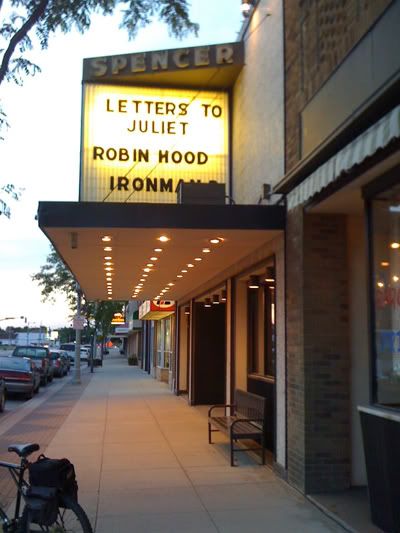
No one will rally ‘round the marquee to save it, and the marquee with its simple “Spencer” will be replaced by a Verizon sign or something similar before year’s end. Sadly, this is reality and not a movie, so the city fathers and farmers have sold their soul for the sake of getting the newest Android phone on release day. Change is inevitable, I guess, like death, some divorces and the Taxman, who cometh and that right soon; but I wish this change hadn’t occurred. The marquee is dark, soon it will be gone and Hawkeye football is only weeks away. I hear they have good tailbacks this year.
There will be no “Save Spencer’s Theater” campaign unless you or someone you know is a billionaire industrialist looking for a million-dollar toy smack dab in the middle of nowhere. Then I know of a project that can be turned into a money pit for the sake of me one day showing something I wrote to my fourth-grade teacher.
Please, think of Mrs. Keck, open your huge wallet and save the damn theater.
Spencer’s theater reopened seven years before Hitler invaded Poland and this is what the marquee looked like. This is what the marquee looked like on what is to date my saddest day of 2010 (and 2010 is nowhere near over):
In 1996 I traveled from the little cow town in Missouri in which I found myself to the Big City of Kansas City? Ever been to KC? It isn’t really a Big City like New York is a Big City, but when twenty years of life had been lived in towns with populations ranging from twelve to seventeen thousand, even something as “big” as Kansas City is a Big City.
I digress.
In 1996 I traveled to KC and did the entire KC thing. The Plaza? Cool. Did you know KC has incredible BBQ? I wouldn’t because the guy with whom I was staying insisted on giving me my first taste of Chinese food. Arrowhead Stadium? It’s about as good a place to see a game as there is. But that wasn’t what got me uber jazzed for the trip. I was going to get to go to the AMC 20 in Independence, Missouri and I’d never seen a place with twenty screens! I’d never seen a town with twenty houses so you can imagine how my mind had difficulty comprehending the bigness of that Big City with its twenty screens. In my little hometown we had a little theater with three screens. Three! Add seventeen to that and asking me to comprehend it would be akin to asking me to explain quantum mechanics.
(Want to hear the best part of the trip to the AMC 20? I got carded for The Frighteners, didn’t have my ID and was turned away. At the time I was twenty but couldn’t convince the pimply face behind the counter I could handle the show.)
So we had a little theater with three screens, but it’s past tense, “had” now. The theater, which was the first thing rebuilt after a massive fire destroyed the town in 1931, closed its doors on Sunday night and is no more. The marquee now reads, “Thank you for the memories” and for the next week or so people will reminisce. They’ll drive past and shake their heads lamenting its passing. Maybe one or two will say, “It’s a damn shame,” but it’ll be forgotten by the time Hawkeye football rolls around.
It is indeed a damn shame.
There’s no way I’d be able to calculate how much time I spent in that theater. In 1978 or 1979 my mom took me there to see Superman: The Movie and I can even now see the destruction of Krypton and remember wondering why the people in white weren’t Storm Troopers. I can remember the lobby, which at that point was then newly remodeled. I can remember going to the bathroom, which looked the same then as it did when the theater closed. Maybe I’m forcing different memories into that first one but, as far back as I can remember, Spencer’s theater is there and part of my life.
My best friend and I would see E.T. each summer when the cheap matinee was shown during the town’s Crazy Days. I frequently went there to see a movie to escape from the Midwestern heat to the comfort of the air conditioning. In 1993 I saw The Sandlot by myself and saw Jenny there with her boyfriend knowing my love would be unrequited that night but not knowing it would be eternally unrequited. I saw Jurassic Park there five times, all alone, marveling at the CGI, thinking I might be seeing the thing that would make the best movies of all time not knowing it would be the downfall of the medium. The night after my last day at high school was spent not huddled around a keg with the rest of my class but at the theater watching Maverick. I saw The Phantom Menace there four times including a 9 p.m. Wednesday show in which I was the only soul in the joint; the only time that’s ever happened. Those are the big ones, the ones I remember.
That little theater made me love movies. It provided an escape from a place where there was a cornfield eight blocks from my front door and made me wonder. It made me think I could write something that might one day appear on screen, and it still might happen because there are still two scripts I cowrote out there with people trying to make them into movies. If not for that rinky-dink little movie theater, I’d have chosen to waste my life in marketing and never wonder about whether I could write a story worth reading.
Oh.
A trip home over Memorial Day allowed me to see one more movie at Spencer’s theater: Iron Man 2. It will be my last so superhero movies opened and closed my experience with the theater. Superman is the vastly superior movie based on the short Smallville sequences alone but I’m not disappointed Iron Man 2 is the last. This week I got a chance to step inside to see the smallest screen completely demolished and the woman who’d worked there for thirty years, one who would have worked the day my mom took me took my first show, didn’t even try to keep from crying.
No one will rally ‘round the marquee to save it, and the marquee with its simple “Spencer” will be replaced by a Verizon sign or something similar before year’s end. Sadly, this is reality and not a movie, so the city fathers and farmers have sold their soul for the sake of getting the newest Android phone on release day. Change is inevitable, I guess, like death, some divorces and the Taxman, who cometh and that right soon; but I wish this change hadn’t occurred. The marquee is dark, soon it will be gone and Hawkeye football is only weeks away. I hear they have good tailbacks this year.
There will be no “Save Spencer’s Theater” campaign unless you or someone you know is a billionaire industrialist looking for a million-dollar toy smack dab in the middle of nowhere. Then I know of a project that can be turned into a money pit for the sake of me one day showing something I wrote to my fourth-grade teacher.
Please, think of Mrs. Keck, open your huge wallet and save the damn theater.
Spencer’s theater reopened seven years before Hitler invaded Poland and this is what the marquee looked like. This is what the marquee looked like on what is to date my saddest day of 2010 (and 2010 is nowhere near over):

Tuesday, August 3, 2010
True Blood Season 3 - A Midseason Review
| by Allan Stackhouse |
How highly can I speak of True Blood? I cannot say. Actually, that's a lie. I was super excited during season 3's buzz campaign but I found myself nervous going into the actual episodes. I wondered if the show could even come close to the magnitude of season 2. Maryann's near infinite power was so delicious, even up until its ravaged end. I was shaken out of this wonder at the last scene of It Hurts Me Too, episode 3. Or should I say my head was twisted all the way around? Too much? In any case, the show proves to be at the level set in season 2.
Ding dong the b*tch is dead. Which old b*tch? Lorena is dead! I've never wanted someone to die so badly since Lorena. She's been a thorn in my side for three seasons but the show did not let me down. Not only did just this one event deliver but the story, acting, and gore all delivered just like the best show on TV is supposed to do. New relationships are formed, old ones are tested, a wide array of villains seek to have their way at the expense of our favorite Bon Temps residents, and of course there's more sex and violence.
Let my hatred for for Lorena not detract from Mariana Klaveno's acting prowess. The control she wields over Lorena's voice and body language is truly astounding. She commands the attention of viewers and this is entirely one of the reasons why she invoked such a strong reaction out of viewers. This bitter hatred I felt was one that I had not felt since Lauren in the third season of JJ Abrams' Alias. Hey, they kind of have the same name. Viewer beware: the Lorena/Laurens of the world will do your favorite TV protagonists harm. They both met their ultimately satisfying end (for the viewers, definitely not them). Whereas Lauren was destroyed in a beautiful hail of bullets, Lorena, held back by Bill with a silver chain that ironically was holding him, is staked by Sookie. A fountain of blood erupts from her mouth and she explodes like a water balloon. A beautiful end worthy of a formidable villain.
Remaining as high as it was, the writing carries us into supernatural ecstasy. We are finding out what Sookie is, a mystery set up in the very first episode of the show. The manifestation of Sookie's powers in the second season and again in the third drew fascination to her. As Sookie recovers in the waiting room, her consciousness is transported to an ethereal realm where other mindreaders reside. The cliffhangers posed at the end of each episode continuously prove to be both amazing and maddening.
New faces to the world of True Blood are the enormously terrifying Russell Edgington, the King of Mississippi. His grip may not reach as far as Maryann's but through his henchman, his influence seems limitless. From Eric's flashback, we (or at least the smarter of the viewers) know that Russell and his pack of werewolves destroyed Eric's royal family. Russell kept this crown as a token of his destruction but to Eric, the crown's value has only grown for about nine hundred seventy-two years. The destruction that Russell so easily casts brings about the emotional side of Eric that we saw in last season. Perhaps not to the point where he cries blood but maybe this crown means even more than that.
Tommy Mickens. The air of mystery was drawn around Tommy and the Mickens family. Episode 6 revealed that he apparently is a contestant in the abhorrent world of dogfights. Honestly, I find this a little silly but this is providing Sam with a sense of family that he did not know he was looking for. Joe Lee and Melinda both turn out to be disgusting people. We know that Sam is capable of caring a lot about his love interests but the care Sam has for his brother is a nice contrast to sex and violence in the show.
The King may be the main villain but Franklin Mott is the character of whom I find myself the most afraid. Lorena might be relentless in her pursuit of Bill but Franklin is absolutely insane. Franklin's tree of insanity does bear fruit though; it comes in the form of Tara's character development. She has had her moments of sadness after Eggs' death but Franklin's pursuit of her leaves Tara no time to worry about that. She's in the fight of her life. The lengths that she's forced to go through surprised me at her ability to rise to the occasion of saving her own and Sookie's lives.
The breakout character this season is not a new one; it's actually Tara Thornton. The growth in her character this season was further than I could have imagined. Despite wanting to die and having been bound and gagged in the earlier episodes, Tara finds the will to survive. And survive she does. Some of the few amazing things she does: bites into Russell's neck and drinks his blood, she smashes Franklin's head into a mess of bone and brain bits, she almost outruns a werewolf, she takes a female werewolf on with her own bare hands, she lifts Bill's body like it's a rag doll, and she kicks Bill out into daylight for nearly killing Sookie.
I read an interview with Alan Ball in which he said the theme of this season was politics whereas the season before had the theme of religion. Alan and everyone involved created another brilliant chess game where, as is usually the case with politics, someone is trying to usurp power. The black king seeks to marry the white queen in order to control not only their respective states but soon the vampire way of life. Franklin is intolerant of of the oppression he feels the Authority over him, having lived in ages when there was no force that made their kind combine with humans.
In retrospect, I don't know if it's fair to say that any of these episodes are better than the other. There's certainly higher stakes in certain episodes, which obviously leads to preference but the theme of politics this season requires a different amount of setup. The results, luckily for us, remain the same: phenomenal characters. We're definitely set up to have an exciting second half of the season. Debbie, as can be told by her screaming, will go to Bon Temps to seek vengeance for Alcide killing Cooter. Franklin is going to pay Tara a visit. And King Russell? His power may continue to grow but I don't think Eric will allow his majesty's reign to go past season 3. 'Til next time, kids!
How highly can I speak of True Blood? I cannot say. Actually, that's a lie. I was super excited during season 3's buzz campaign but I found myself nervous going into the actual episodes. I wondered if the show could even come close to the magnitude of season 2. Maryann's near infinite power was so delicious, even up until its ravaged end. I was shaken out of this wonder at the last scene of It Hurts Me Too, episode 3. Or should I say my head was twisted all the way around? Too much? In any case, the show proves to be at the level set in season 2.
Ding dong the b*tch is dead. Which old b*tch? Lorena is dead! I've never wanted someone to die so badly since Lorena. She's been a thorn in my side for three seasons but the show did not let me down. Not only did just this one event deliver but the story, acting, and gore all delivered just like the best show on TV is supposed to do. New relationships are formed, old ones are tested, a wide array of villains seek to have their way at the expense of our favorite Bon Temps residents, and of course there's more sex and violence.
Let my hatred for for Lorena not detract from Mariana Klaveno's acting prowess. The control she wields over Lorena's voice and body language is truly astounding. She commands the attention of viewers and this is entirely one of the reasons why she invoked such a strong reaction out of viewers. This bitter hatred I felt was one that I had not felt since Lauren in the third season of JJ Abrams' Alias. Hey, they kind of have the same name. Viewer beware: the Lorena/Laurens of the world will do your favorite TV protagonists harm. They both met their ultimately satisfying end (for the viewers, definitely not them). Whereas Lauren was destroyed in a beautiful hail of bullets, Lorena, held back by Bill with a silver chain that ironically was holding him, is staked by Sookie. A fountain of blood erupts from her mouth and she explodes like a water balloon. A beautiful end worthy of a formidable villain.
Remaining as high as it was, the writing carries us into supernatural ecstasy. We are finding out what Sookie is, a mystery set up in the very first episode of the show. The manifestation of Sookie's powers in the second season and again in the third drew fascination to her. As Sookie recovers in the waiting room, her consciousness is transported to an ethereal realm where other mindreaders reside. The cliffhangers posed at the end of each episode continuously prove to be both amazing and maddening.
New faces to the world of True Blood are the enormously terrifying Russell Edgington, the King of Mississippi. His grip may not reach as far as Maryann's but through his henchman, his influence seems limitless. From Eric's flashback, we (or at least the smarter of the viewers) know that Russell and his pack of werewolves destroyed Eric's royal family. Russell kept this crown as a token of his destruction but to Eric, the crown's value has only grown for about nine hundred seventy-two years. The destruction that Russell so easily casts brings about the emotional side of Eric that we saw in last season. Perhaps not to the point where he cries blood but maybe this crown means even more than that.
Tommy Mickens. The air of mystery was drawn around Tommy and the Mickens family. Episode 6 revealed that he apparently is a contestant in the abhorrent world of dogfights. Honestly, I find this a little silly but this is providing Sam with a sense of family that he did not know he was looking for. Joe Lee and Melinda both turn out to be disgusting people. We know that Sam is capable of caring a lot about his love interests but the care Sam has for his brother is a nice contrast to sex and violence in the show.
The King may be the main villain but Franklin Mott is the character of whom I find myself the most afraid. Lorena might be relentless in her pursuit of Bill but Franklin is absolutely insane. Franklin's tree of insanity does bear fruit though; it comes in the form of Tara's character development. She has had her moments of sadness after Eggs' death but Franklin's pursuit of her leaves Tara no time to worry about that. She's in the fight of her life. The lengths that she's forced to go through surprised me at her ability to rise to the occasion of saving her own and Sookie's lives.
The breakout character this season is not a new one; it's actually Tara Thornton. The growth in her character this season was further than I could have imagined. Despite wanting to die and having been bound and gagged in the earlier episodes, Tara finds the will to survive. And survive she does. Some of the few amazing things she does: bites into Russell's neck and drinks his blood, she smashes Franklin's head into a mess of bone and brain bits, she almost outruns a werewolf, she takes a female werewolf on with her own bare hands, she lifts Bill's body like it's a rag doll, and she kicks Bill out into daylight for nearly killing Sookie.
I read an interview with Alan Ball in which he said the theme of this season was politics whereas the season before had the theme of religion. Alan and everyone involved created another brilliant chess game where, as is usually the case with politics, someone is trying to usurp power. The black king seeks to marry the white queen in order to control not only their respective states but soon the vampire way of life. Franklin is intolerant of of the oppression he feels the Authority over him, having lived in ages when there was no force that made their kind combine with humans.
In retrospect, I don't know if it's fair to say that any of these episodes are better than the other. There's certainly higher stakes in certain episodes, which obviously leads to preference but the theme of politics this season requires a different amount of setup. The results, luckily for us, remain the same: phenomenal characters. We're definitely set up to have an exciting second half of the season. Debbie, as can be told by her screaming, will go to Bon Temps to seek vengeance for Alcide killing Cooter. Franklin is going to pay Tara a visit. And King Russell? His power may continue to grow but I don't think Eric will allow his majesty's reign to go past season 3. 'Til next time, kids!
Subscribe to:
Posts (Atom)